Proxy networks
Several servers behind one address, behaving like one.
On a single server there is nothing on this page to set up, and nothing here runs. Put the same jar on every server behind a Velocity or BungeeCord proxy, add one small plugin to the proxy, and chat, private messages, teleport requests and the player list start crossing between them. No database, no open port, no password.
What crosses
| From one server to another | How it looks |
|---|---|
| Chat | [Paper] Steve » hello - the prefix says where it came from |
/msg and /r |
Arrives in the reader's own language, with a Reply button on Java |
/tpa and /tpahere |
The request crosses; the teleport waits for consent on their side |
/tp and /tphere |
Moves the player between servers, then to the target |
/glist |
Everyone on the network, grouped by server |
/server |
Switch to a named server |
| Tab completion | /msg, /tp and /tpa suggest names from every server |
Homes, warps, mail, money and player warps cross too - but not through the bridge. They are data, not messages, and carrying data over a chat channel is how plugins lose it. They cross through a shared database; see below.
Claims never cross. A claim is bound to a world on one server, and two servers
both calling their overworld world would hand a player somebody else's land.
Setting it up
On the proxy, drop EmberBridge.jar into plugins/. It is a separate,
free download - a proxy plugin, not a server one - and the one jar runs on
either Velocity or BungeeCord; each proxy reads its own manifest and ignores
the other's.
On every backend, in config.yml:
bridge:
  enabled: true          # already the default

cross-server-chat:
  enabled: true
  server-name: "Paper"   # what the prefix says. Blank uses the MOTD
  channels:
    - global             # which channels cross. local stays local
    - staff
  format: "<#546e7a>[%server%] <reset>%message%"
Restart the backends, then the proxy. Order matters only in that the proxy is the last thing to come up; a backend that starts after the proxy is fine.
The usual proxy prerequisites still apply and are the proxy's documentation,
not ours: online-mode=false on the backends, modern forwarding with a
matching secret on Velocity, and nothing else able to reach the backend ports
directly.
Shared storage
One setting turns the plugin's files into rows in MySQL or MariaDB:
Put the same settings on every server. From then on these are one set of data across the network: homes, warps, mail, kit and playtime claims, tag and perk choices, Discord links, jail sentences, balances, and player warps. A home set on one server is there on the next. Mail arrives wherever you log in. Money is one number everywhere.
Existing files are imported the first time a server starts on the database,
and kept beside the plugin as *.yml.migrated in case you want them back. A
server joining a network that already has data does not overwrite it.
Claims, portals, holograms, signs, spawn and everything else bound to a world stay in files on their own server. That list is not configurable, because sharing it would be a bug rather than a feature.
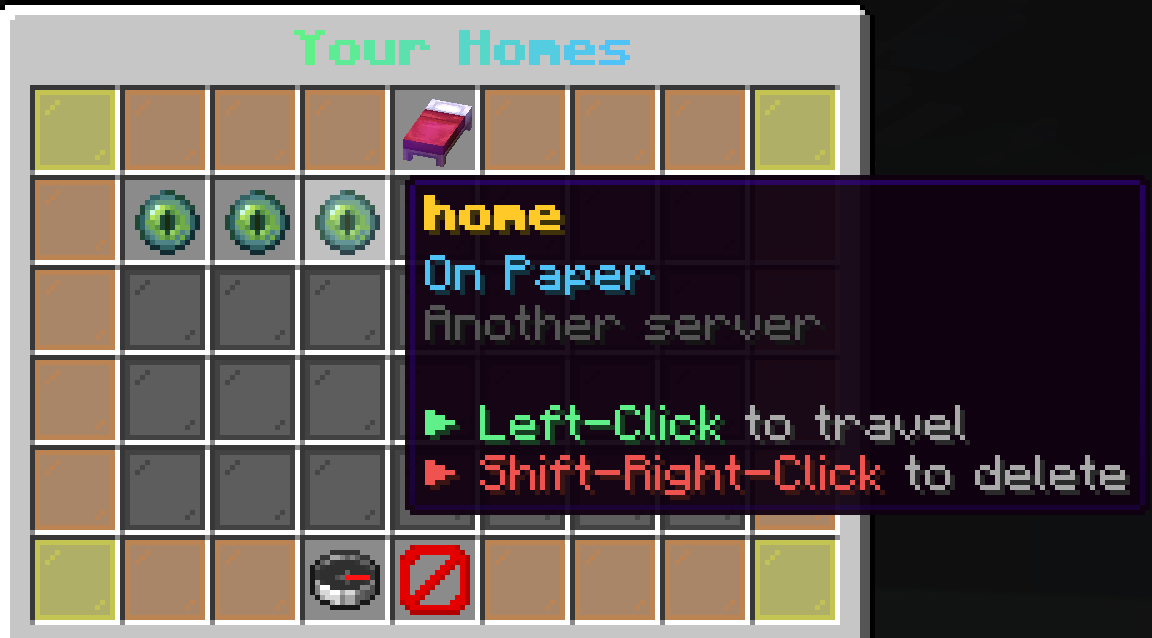
A home on another server
A home or warp remembers which server it was set on. Use one from elsewhere
and the plugin sends you across through Ember Bridge, then finishes the
teleport when you land - with warmup and /back behaving exactly as they do
for a local one. The menus show these with the server's name in place of
coordinates.
Money without another plugin
Where no economy plugin is installed, the plugin keeps its own ledger, and on the database backend that ledger is shared. With Ember Coins or any Vault economy installed, those are used instead; nothing changes.
Two knobs, for owners who want it a particular way:
economy.builtin: neverturns the ledger off. Money features then wait for Ember Coins or a Vault economy and say so, rather than quietly keeping a balance you did not ask for./essentials importbalancesmoves everything the ledger holds into the economy that has since taken over. One way, and only once that economy is live; anything that cannot be paid out stays in the ledger and is reported.
Paper ships the drivers
Paper already bundles the MariaDB and MySQL JDBC drivers, so there is nothing to download. On a server that does not have them, the plugin fetches the MariaDB driver itself on first start.
How it works, and what that costs
Everything travels on a plugin message channel, which is the pipe the game already has between a proxy and a backend. A plugin message is carried by a player's connection, so a message can only leave a server while somebody is on it. For chat that is exactly right: a line nobody was there to say has nobody to read it. For a private message to a player on an empty server the proxy answers that they are not on the network, and nothing is queued.
Tab completion is served from a copy of the network roster refreshed every twenty seconds. A name can be that stale in the suggestions; the command itself still checks.
Bedrock
Chat, messages and teleports all work for Bedrock players. Two things differ, and both are the platform rather than the plugin:
- Messages arrive as one plain line rather than a framed window, because Bedrock cannot draw the frame and its narrower chat column would wrap the title.
- Tab completion does not reach Bedrock. Geyser only translates the static command list; suggestions computed on the server never arrive.
For Bedrock chat to work at all on a network, force-key-authentication
must be false on Velocity and enforce-secure-profile false on every
backend. Bedrock players have no chat signing key, and either setting alone
blocks them silently.
With other Ember plugins
Ember Coins loads before Ember Essentials on purpose, so where both are
installed Coins owns /balance, /pay, /baltop and /eco. Essentials
uses Coins as its currency, so both read the same ledger; there is nothing to
configure and no double economy.
In pictures
What it looks like in game. Every shot is from a live server, unedited apart from cropping.