Benchmarks
Every number here links to how it was produced. Anything not on this page is not a claim EmberMC makes.
R4 - Entity tiers via /ember bench, ~8,000 mobs
Reproducing R3 at higher density with the shipped command. One player anchoring
about 8,000 ground-standing zombies (AI on, spread across the activation disc),
/ember bench 10 cycling the tier and reading the entity phase over 10 s each.
vanilla is the tiers off, the same box behaving as plain Paper.
| Tier | entity phase (10 s mean) | vs vanilla |
|---|---|---|
| vanilla (= Paper) | 51.09 ms | baseline |
| balanced | 17.99 ms | 65% lower |
| performance | 9.06 ms | 82% lower |
| extreme | 9.07 ms | 82% lower |
At this density vanilla is over the 50 ms budget (the server dipping under 20
TPS); the tiers pull it back to about 9 ms with room to spare. Reproduce it on
your own load with /ember bench; the vanilla row is your own Paper baseline,
not a figure from another machine.
R5 - Redstone re-validated live on the current build
A 31x31 dust plane (961 blocks) driven by a two-observer clock, force-loaded, no
players; the engine switched with misc.redstone-implementation and a restart.
| Redstone engine | block-ticks phase (5 s mean) |
|---|---|
| Vanilla (Paper default) | ~1.27 ms |
| Alternate Current (EmberMC default) | 0.14 ms |
About 9x lower, in line with R1.
R3 - Entity tiers: EmberMC vs Paper behaviour, one player, 2,037 mobs
A player standing in a disc of AI zombies (2,037 entities, spawning off) on the
ember-folia box. The tier was switched with /ember reload on the same
running server, same mobs, same second - so OFF is EmberMC ticking every
in-range mob fully, exactly as regular Paper does, with none of the noise of
comparing two containers.
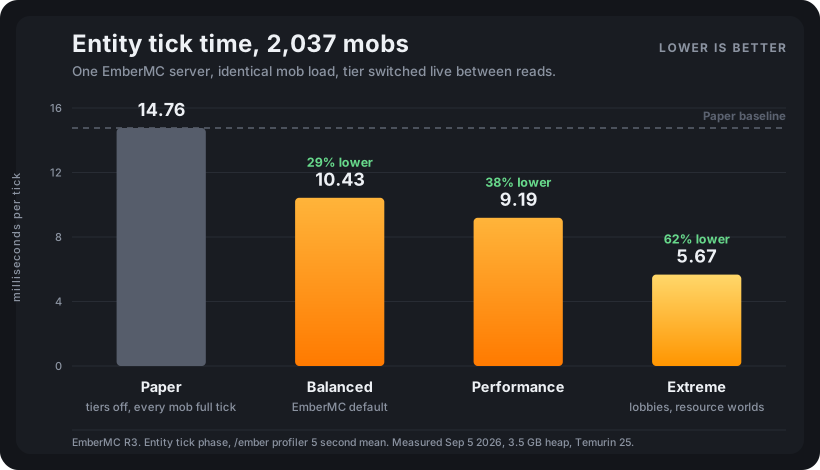
| Tier | entity-tick phase | MSPT (5 s avg) |
|---|---|---|
| OFF - regular Paper behaviour | 14.76 ms | 16.7 ms |
| balanced | 10.43 ms | 12.0 ms |
| performance | 9.19 ms | 11.0 ms |
| extreme | 5.67 ms | 6.5 ms |
Entity phase vs Paper: balanced -29 %, performance -38 %, extreme -62 %. And the promise held - every mob inside the player's full ring kept ticking fully at all four settings; only the outer ring was slowed. One run per tier, idle wandering mobs rather than a real farm; it shows the mechanism at the predicted scale, and the profiler is how you measure it on your own server.
R2 - Redstone: Paper vs Purpur vs EmberMC, same host
Three containers on one InterServer host, each idle apart from the rig,
Temurin 25, 3.5 GB heap. Rig: a 31×31 plane of redstone dust (961 blocks) on
smooth stone, driven by a two-observer clock feeding one corner, area
force-loaded, no players. Yardstick: /mspt, 5-second window, read ~20 s after
the rig was built.
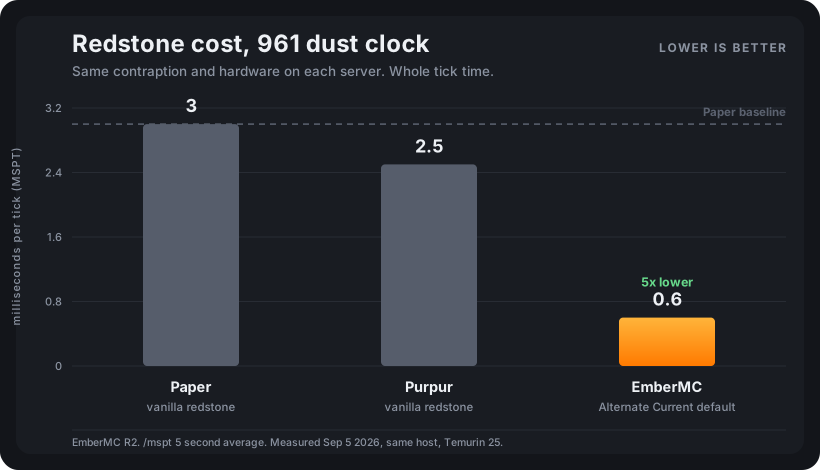
| Server | Redstone engine | avg | max |
|---|---|---|---|
| Paper (stock) | vanilla (default) | 3.0 ms | 16.7 ms |
| Purpur 26.2 (stock) | vanilla (default) | 2.5 ms | 13.0 ms |
| EmberMC | Alternate Current (default) | 0.6 ms | 1.2 ms |
What this does and does not show. The engine difference is the story: Alternate Current is Paper's own redstone engine, shipped but off by default; EmberMC turns it on. Purpur's slightly lower vanilla figure is within the noise of three containers sharing a host. One run each.
Side finding. Every server's idle window showed a 0.3-1.9 s tick every five
minutes - the autosave. Stock Paper's 10-second column read 1825.8 max. Only
EmberMC's watchdog reported it; from the current build it is its own profiler
phase, so the report says autosave rather than other.
R1 - Redstone engine, engine-vs-engine on one server
Same rig, same EmberMC server, switched live with
misc.redstone-implementation + /paper reload, read on /ember profiler
(block-ticks phase, 5-second window).
| Engine | mean | p95 |
|---|---|---|
| vanilla | 2.20 ms | 9.25 ms |
| Alternate Current | 0.20 ms | 0.74 ms |
Pending
Entity tiers (Milestone 4) - needs a player standing in a 400-500 zombie
pen while the tier is switched off / balanced / performance / extreme with
/ember reload. With nobody online Paper deactivates every mob and there is
nothing to measure. Will be recorded here when run.
Method
- Same machine, same JVM, same flags, same world, same plugins, back to back.
- Three runs per scenario per server once the harness exists; today's entries are single runs and say so.
- Warm-up before measuring; a stated window; the exact build hash.
- A result that cannot be reproduced from its description is not a result.